
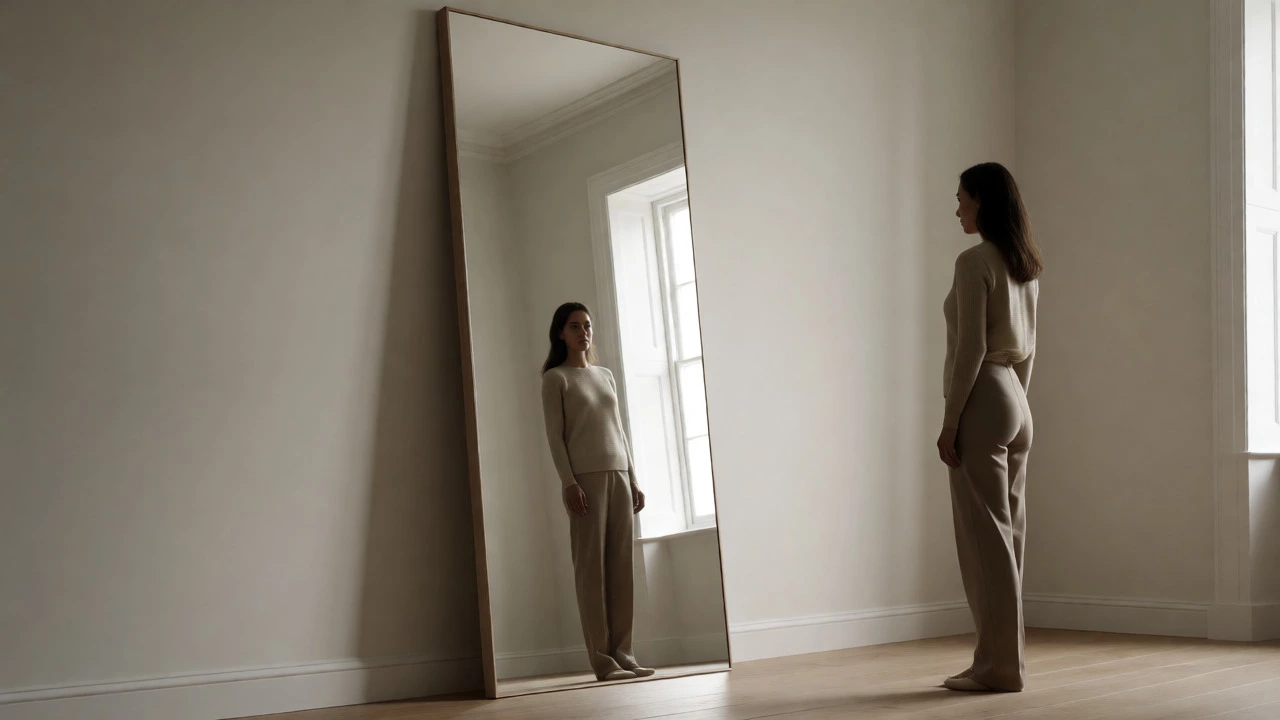
Mirror Illusion Simulator
Adjust the settings below to see how different factors influence your reflection's perceived proportions according to the article's findings.
Simulated Reflection
You stand in front of the bathroom mirror, turn sideways, and squint. Then you walk into your bedroom, face that giant full-length leaning against the wall, and suddenly you feel like a different person. Taller? Slimmer? Or maybe just distorted? It’s a question every homeowner wrestles with when deciding whether to buy one: do full-length mirrors make you look thinner, or is it just wishful thinking?
The short answer is yes, but not because the glass magically shrinks your waistline. It’s about physics, angles, and how your brain processes visual information. A well-placed full-length mirror doesn’t change your body; it changes the frame around it. But get the placement wrong, and you might end up looking wider than you actually are. Let’s break down exactly how this works so you can hang your next mirror without second-guessing your reflection.
The Science Behind the Reflection
Mirrors don’t lie, but they do distort. When you look at yourself in a standard vertical mirror, you’re seeing a direct, 1:1 ratio of your height and width. However, human vision isn’t a camera lens; it’s a cognitive process. Your brain interprets depth, width, and proportion based on context clues surrounding the subject. This is where the concept of the Mirror Illusion comes into play. It refers to the perceptual shift that occurs when visual cues-like the edges of a mirror frame or the angle of reflection-alter how we perceive size and shape.
Think about wearing black clothes. They absorb light, reducing the visual contrast between your body and the background, which makes you appear smaller. A full-length mirror acts similarly by providing a continuous vertical line. If the mirror is tall enough to capture your entire silhouette without cutting off your head or feet, it creates an uninterrupted vertical axis. Vertical lines naturally draw the eye up and down rather than side-to-side. This is a basic principle of interior design known as vertical elongation. By emphasizing height over width, the mirror tricks your brain into perceiving a slimmer profile.
But here’s the catch: if the mirror is too narrow, it cuts off parts of your body. This fragmentation forces your brain to fill in the gaps, often resulting in a distorted sense of proportion. You might think you look narrower because you can’t see your hips or shoulders fully, but you’re also losing the context needed for accurate self-assessment. So, while a narrow strip might flatter, it doesn’t necessarily give you an honest view of your physique.
Placement Matters More Than Size
You could have the most expensive, pristine glass in town, but if you stick it on a wall facing a cluttered corner or under harsh overhead lighting, you won’t get that slimming effect. Placement is everything. The golden rule? Position the mirror where it reflects light and open space, not shadows and clutter.
Lighting plays a huge role in how reflective surfaces behave. Natural light from a window opposite the mirror bounces back into the room, brightening your complexion and softening shadows that might otherwise accentuate curves or folds. Harsh, top-down artificial light, however, casts downward shadows under your eyes, nose, and chin, creating a gaunt or tired appearance that doesn’t equate to "thinner" but rather "harsher."
Consider the angle. Most people mount their full-length mirrors perfectly parallel to the wall. While this is accurate, tilting the bottom of the mirror slightly toward the wall (about 5-10 degrees) can create a subtle upward tilt in the reflection. This slight incline elongates the legs and torso, enhancing that vertical stretch. It’s a trick used in high-end retail fitting rooms worldwide. You’re not bending the light; you’re changing the perspective from which you view yourself.
| Placement Scenario | Visual Effect | Best For |
|---|---|---|
| Parallel to Wall | True-to-life proportions; neutral reflection | Accurate outfit checks; realistic self-view |
| Tilted Bottom Toward Wall | Elongates legs and torso; slimming illusion | Dressing areas; flattering daily check-ins |
| Facing Window/Light Source | Brightens skin tone; reduces shadow depth | Vanity areas; makeup application |
| Facing Dark Corner | Absorbs light; increases contrast/shadows | Not recommended for slimming effects |
Frame Width and Shape Influence
It’s not just about the glass; it’s about the border. A thick, ornate frame draws attention to itself, breaking the continuity of the reflection. A thin, minimalist frame-or better yet, a frameless edge-allows the eye to slide past the boundary and focus solely on the reflected image. This lack of interruption helps maintain the vertical flow we talked about earlier.
What about shape? Rectangular mirrors are the standard for a reason. Their straight lines reinforce the vertical axis. Arched or oval mirrors soften the edges, which can be aesthetically pleasing but may not provide the same structural slimming cue. If you’re trying to create an illusion of height and slimness, stick to clean, rectangular lines. Avoid round mirrors for full-body reflections unless they are exceptionally large, as they tend to cut off limbs awkwardly, disrupting the silhouette.
Also, consider the material of the frame. Dark frames against light walls create a strong contrast that defines the mirror’s boundaries clearly. Light frames on light walls blend in, making the mirror seem like a window into another space. This "window effect" expands the perceived depth of the room, which indirectly makes you feel less confined and, psychologically, lighter.
The Psychology of Self-Perception
We need to talk about why we care so much. Do full-length mirrors make you look thinner? Part of the answer lies in psychology, not just optics. There’s a phenomenon called "body dysmorphia" or simply general dissatisfaction with one’s reflection. When you look in a small bathroom mirror, you’re close to the glass. Proximity exaggerates features. Your nose looks bigger; your face looks wider. This is due to focal length distortion, similar to taking a selfie with a wide-angle lens up close.
A full-length mirror requires you to step back. Standing three to four feet away normalizes facial proportions and gives you a holistic view of your posture. Good posture alone can make anyone look ten pounds lighter. When you see your whole body, you’re more likely to notice if you’re slouching. Correcting your stance engages your core, lifts your chest, and aligns your spine. The mirror isn’t shrinking you; it’s prompting you to stand taller.
This feedback loop is powerful. In Bristol, where I live, many historic homes have low ceilings and narrow hallways. Installing a full-length mirror in these spaces doesn’t just help with dressing; it opens up the psychological weight of the room. Feeling spacious reduces stress, and a relaxed body language reads as more confident and attractive to others-and to yourself.
Common Mistakes That Ruin the Illusion
So, you bought the mirror. Now, don’t sabotage it. Here are the most common errors people make:
- Hanging it too high: If the center of the mirror is above eye level, you’ll have to look down to see your torso. This foreshortens your upper body, making your head look larger and your torso shorter. Center the mirror so that the midpoint is roughly at your eye level.
- Placing it opposite a messy bed: If your reflection includes a pile of laundry or an unmade bed, your brain associates those chaotic elements with your image. Keep the reflected area tidy to maintain a clean, streamlined visual field.
- Ignoring floor color: Dark floors absorb light, grounding the reflection heavily. Lighter floors reflect more light upward, helping to lift the visual weight of the lower body. If you have dark wood floors, consider adding a light-colored rug in front of the mirror.
- Using convex mirrors: Some decorative mirrors curve outward. These widen the field of view but distort shapes, often making objects appear smaller and farther away. While this can technically make you look smaller, it often looks unnatural and fish-eye-like. Stick to flat glass for accuracy.
Choosing the Right Mirror for Your Space
Not all full-length mirrors are created equal. When shopping, look for specific attributes that enhance the slimming effect. First, check the aspect ratio. A mirror that is significantly taller than it is wide (e.g., 24 inches wide by 60 inches tall) will emphasize height more than a square-ish mirror. Second, inspect the glass quality. Low-quality glass has a greenish tint and poor clarity, which can dull your reflection and hide details. High-clarity glass offers a crisp, true-color representation.
If you’re renting or can’t drill holes, lean-on-the-wall mirrors are fantastic. They allow for easy adjustment of the tilt angle mentioned earlier. Just ensure the base is stable. For permanent installations, wall-mounted options offer a sleeker look but require precise leveling. Even a slight tilt backward (top away from the wall) can shorten your reflection, which is the opposite of what you want.
Another option is a mirrored wardrobe door. This integrates storage and reflection seamlessly. Because it’s part of a larger furniture piece, it anchors the room while still providing the full-body view. It’s particularly effective in bedrooms where space is limited.
Does the distance from the mirror affect how thin I look?
Yes. Standing closer to a mirror exaggerates features due to perspective distortion, similar to a wide-angle camera lens. Stepping back creates a more proportional view. Generally, standing 3-4 feet away provides the most balanced and flattering reflection, allowing your full silhouette to be seen without distortion.
Are curved mirrors better for slimming?
Convex (outward-curving) mirrors do make images appear smaller and wider, which can create a slimming illusion. However, they also distort proportions, making your reflection look unnatural. Flat mirrors with proper lighting and vertical framing are usually preferred for a realistic yet flattering view.
How does lighting impact my reflection in a full-length mirror?
Lighting is critical. Soft, diffuse light coming from the front or sides minimizes shadows and highlights, smoothing out textures and contours. Harsh overhead lighting casts deep shadows that can emphasize volume and unevenness. Aim for warm, ambient light sources near the mirror to create a glowing, softer appearance.
Can a mirror make me look fatter?
Yes, if placed incorrectly. Concave mirrors (curving inward) magnify images, making you look larger. Additionally, placing a mirror in a dimly lit corner or facing a dark, cluttered background can increase visual weight through contrast and shadow, potentially making you appear heavier than you are.
Is there a difference between silver and aluminum mirrors?
Silver mirrors generally offer higher reflectivity and clearer, truer colors compared to aluminum mirrors. Aluminum mirrors are cheaper but can have a slight bluish or grayish tint and lower brightness. For the best aesthetic result and accurate color representation, silver-backed mirrors are superior.