
Infinite Mirror Simulator
Adjust the parameters below to simulate how light bounces between two parallel mirrors. Notice how higher reflectivity allows you to see deeper into the "tunnel," while lower reflectivity causes images to fade quickly.
Simulation Results
Total Visible Bounces: --
Light Remaining at Last Visible Bounce: --
*Based on a visual threshold of 1% original light intensity.*
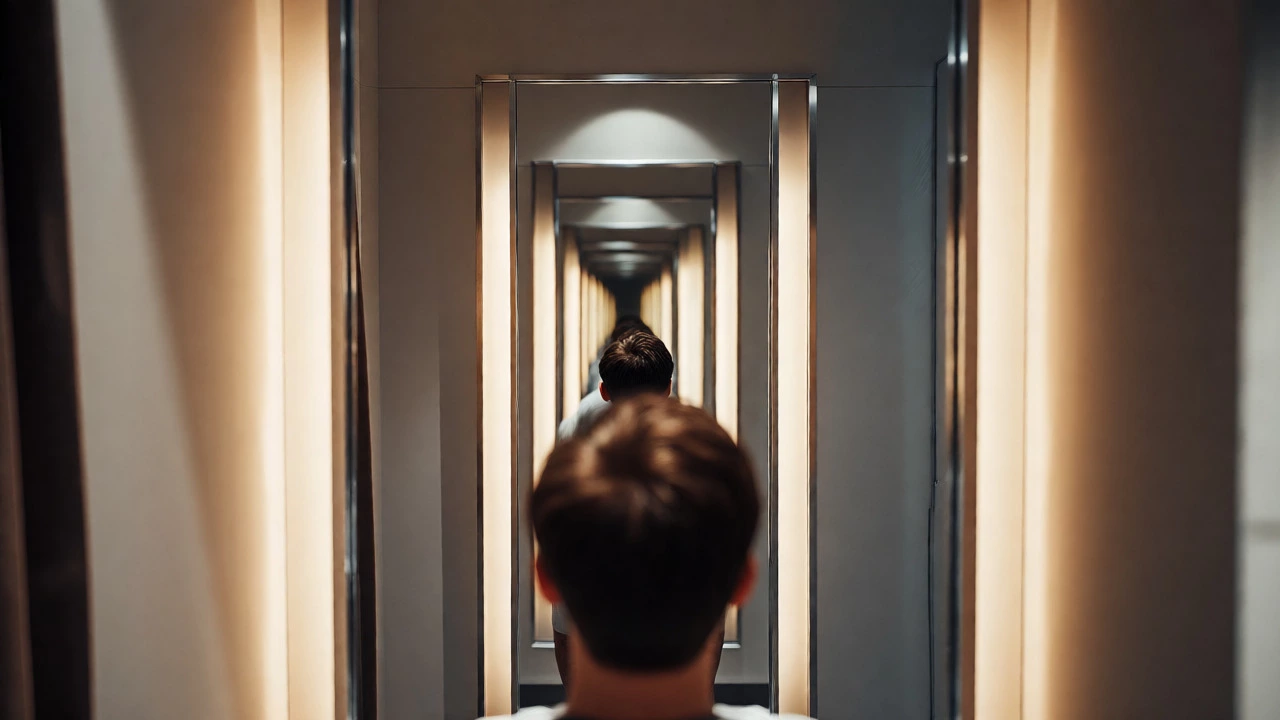
You’ve probably done it as a kid in a fitting room or a barber shop. You stand between two mirrors facing each other and watch your reflection stretch on forever, a tunnel of you disappearing into the distance. It looks like magic, but it’s just physics doing its job with impressive efficiency. The phenomenon is known as the infinite mirror effect, created when light bounces back and forth between two reflective surfaces.
But does it really go on forever? If you look closely at that endless corridor of reflections, you’ll notice something odd. The images get darker, blurrier, and eventually vanish. Why? Because no mirror is perfect. Every time light hits a mirror, a tiny bit of energy is absorbed rather than reflected. This article breaks down exactly what happens to the light, why the tunnel fades, and how you can actually use this trick to make small rooms feel huge.
The Physics of Parallel Reflections
When you place two flat mirrors directly opposite each other, you create a closed loop for photons. Light from an object (like your face) travels to the first mirror, reflects off it, travels to the second mirror, reflects again, and so on. Each bounce creates a new virtual image behind the mirror surface. Since the mirrors are parallel, these images align perfectly, stacking one behind the other.
This isn't just about seeing more of yourself. It's about understanding how light reflection works under constrained conditions. In an open space, light scatters in all directions. Between two parallel mirrors, the light is trapped in a specific path until it loses enough energy to become invisible to your eye.
The number of visible reflections depends on three main factors:
- Mirror Quality: High-end silvered glass reflects about 95% of visible light. Cheap bathroom mirrors might only reflect 80-85%.
- Distance: The further apart the mirrors are, the more air the light has to travel through, leading to more scattering and absorption.
- Light Source Intensity: Brighter light means more photons survive the initial bounces, allowing you to see deeper into the "tunnel."
Why the Tunnel Eventually Fades
If mirrors were 100% efficient, the tunnel would indeed be infinite. But real-world materials have limits. Standard household mirrors are typically made by coating a sheet of glass with a thin layer of aluminum or silver. This coating isn't perfect. It absorbs a small percentage of light with every hit.
Let’s do some quick math. Imagine a decent mirror reflects 90% of the light hitting it. That means 10% is lost as heat or absorbed by the glass substrate.
- Bounce 1: 90% of original light remains.
- Bounce 2: 90% of 90% = 81% remains.
- Bounce 3: 90% of 81% = 72.9% remains.
- Bounce 10: Less than 35% remains.
- Bounce 20: Less than 12% remains.
By the time the light has bounced 20 times, it’s too dim for your eyes to distinguish the image from the background darkness. This is why the infinite tunnel has an end point-it’s not that the images stop existing, but that they become too faint to see. The rate of decay is exponential, meaning the drop-off gets faster as you look deeper.
Absolute vs. Relative Infinity
There’s a difference between mathematical infinity and practical visibility. Mathematically, if you ignore absorption, the series of images goes on forever. Practically, your human eye has a threshold for contrast and brightness. Once the reflected light drops below that threshold, the brain stops registering the image.
You can test this in a darkened room. Use a bright flashlight pointed between two high-quality mirrors. You’ll likely see fewer distinct steps than you think because the glare washes out the subtle differences between reflections. Conversely, in a very bright room with low-quality mirrors, the tunnel might seem shorter because ambient light overwhelms the faint distant reflections.
The Role of Angle: Beyond Parallel
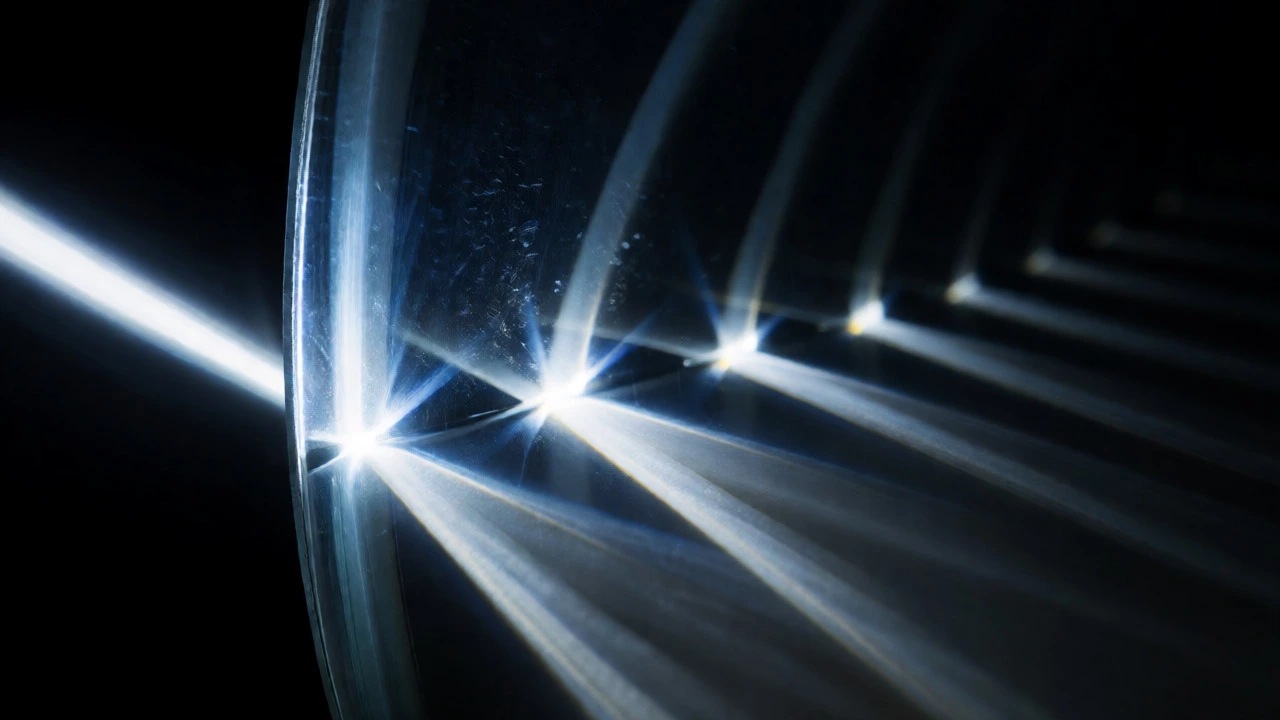
What if you tilt the mirrors? The infinite tunnel disappears instantly. Instead of a straight line of receding images, you get a circular pattern or a fragmented mosaic. This is because the angle changes the path of the light. If the mirrors aren’t perfectly parallel, the light beam will eventually drift out of the gap between them after a certain number of bounces.
Here is how different angles affect the view:
| Angle Between Mirrors | Visual Result | Physics Explanation |
|---|---|---|
| 0° (Parallel) | Infinite linear tunnel | Light stays trapped between surfaces until absorbed. |
| Small Tilt (<5°) | Fading curved arc | Light gradually escapes the side gaps; images curve away. |
| 60° | Five distinct images | Formula: (360/angle) - 1. Light exits after limited bounces. |
| 90° | Three images (plus original) | Common in bathroom cabinets; clear separation of views. |
Notice the formula for non-parallel mirrors: Number of Images = (360 / Angle) - 1. This only works if 360 divides evenly by the angle. If it doesn’t, you get fractional images that look cut off or distorted.
Practical Applications in Home Design
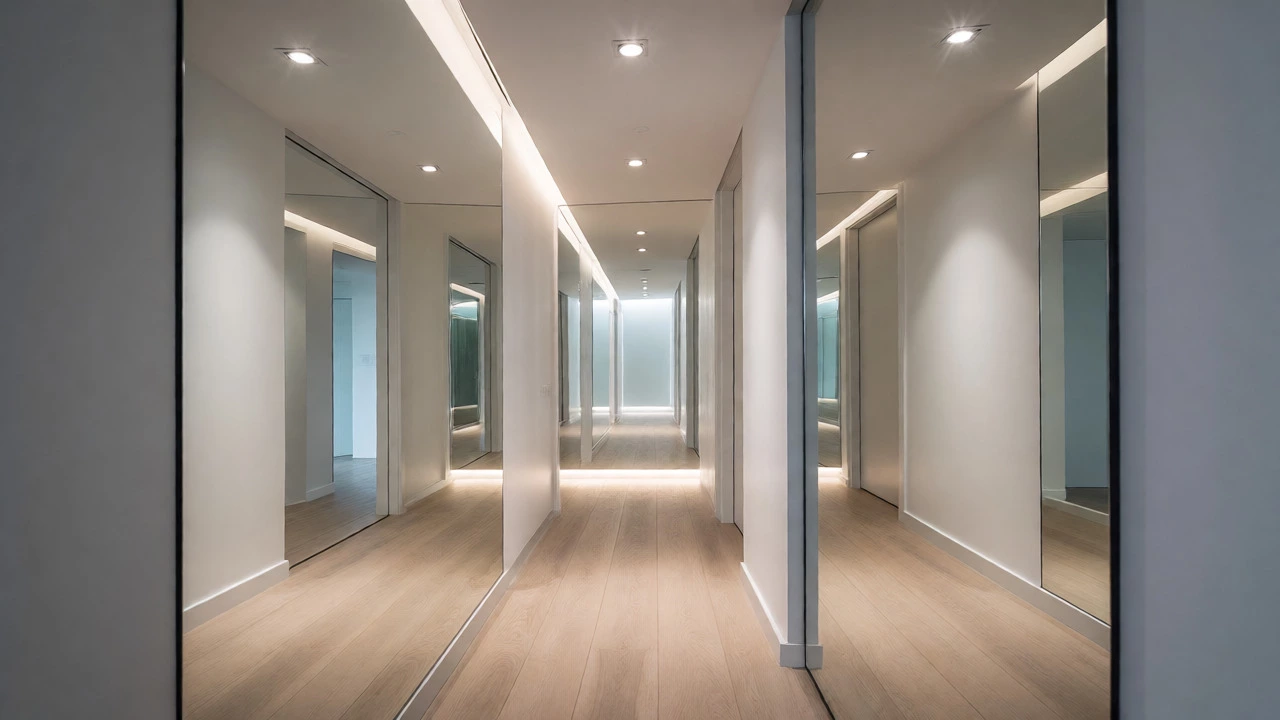
You don’t need a physics lab to use this effect. Interior designers love the infinite mirror trick for making small spaces feel larger. A classic example is the hallway. By placing a large mirror at the end of a narrow corridor and another on the side wall (or vice versa), you create a visual depth that tricks the brain into thinking the room extends far beyond its physical walls.
However, there’s a catch. If the alignment is off by even a degree, the effect breaks. The reflections will appear disjointed, creating a dizzying, chaotic look rather than a clean extension of space. Precision matters here. Using laser levels during installation ensures the mirrors remain truly parallel.
Another popular application is the "infinity mirror" art piece. These are usually framed boxes with a standard mirror on the back and a two-way mirror on the front, with LED lights sandwiched between them. The LEDs reflect back and forth between the two surfaces, creating a glowing, deep-looking void. This isn’t quite the same as natural daylight reflection because the light source is internal and controlled, but the principle of repeated reflection is identical.
Troubleshooting Common Issues
If you’re trying to recreate this effect at home and it’s not working, check these common pitfalls:
- Gaps: Even a millimeter gap between the frame and the wall can let light escape, shortening the tunnel.
- Cleanliness: Dust and fingerprints absorb light. A smudged mirror kills the clarity of distant reflections quickly.
- Lighting Direction: If the light source is behind you, it illuminates your face well, but the reflections might be shadowed. Try diffuse lighting from the side.
- Glass Thickness: Thick glass causes double reflections (ghosting). Thin, high-quality float glass minimizes this distortion.
The Science of Perception
Your brain plays a role here too. We interpret size based on perspective cues. In an infinite mirror, those cues repeat endlessly. Your brain struggles to process the lack of a vanishing point, which can sometimes cause mild vertigo or disorientation if you stare too long. This is similar to the feeling you get looking down a very deep shaft or escalator.
Interestingly, cameras capture this differently than our eyes. Smartphone cameras often struggle with dynamic range. They might blow out the bright foreground reflections while keeping the background black, missing the gradual fade-out that your eyes perceive naturally. To photograph an infinite mirror properly, you need to manually adjust exposure to balance the bright near-images with the dim far-images.
Do mirrors reflect light infinitely?
Mathematically, yes, if the mirrors were 100% reflective. Physically, no. All real mirrors absorb a small percentage of light (usually 4-10%) with each bounce. Eventually, the light becomes too dim to see, effectively ending the visible sequence after 10-30 reflections depending on quality.
Why do the reflections get darker?
Each time light hits a mirror, some energy is converted to heat or absorbed by the glass and metal coating. This loss compounds exponentially. After several bounces, the remaining light intensity drops below the threshold of human vision.
Can I create an infinite mirror effect with any two mirrors?
Yes, but the quality varies. Two cheap bathroom mirrors placed close together will show fewer, blurrier reflections than two high-quality optical mirrors placed further apart. Alignment must be precise; even a slight tilt ruins the linear tunnel effect.
What is a two-way mirror?
A two-way mirror (or semi-transparent mirror) allows light to pass through from one side while reflecting it from the other. It is essential for creating artificial infinity mirrors with LED lights, as it lets you see into the box while reflecting the internal light back and forth.
Does the distance between mirrors matter?
Yes. Greater distance means light travels farther between bounces, increasing the chance of scattering and absorption by air particles. Closer mirrors preserve light intensity better, potentially showing more distinct reflections, though the total "depth" may appear smaller.