
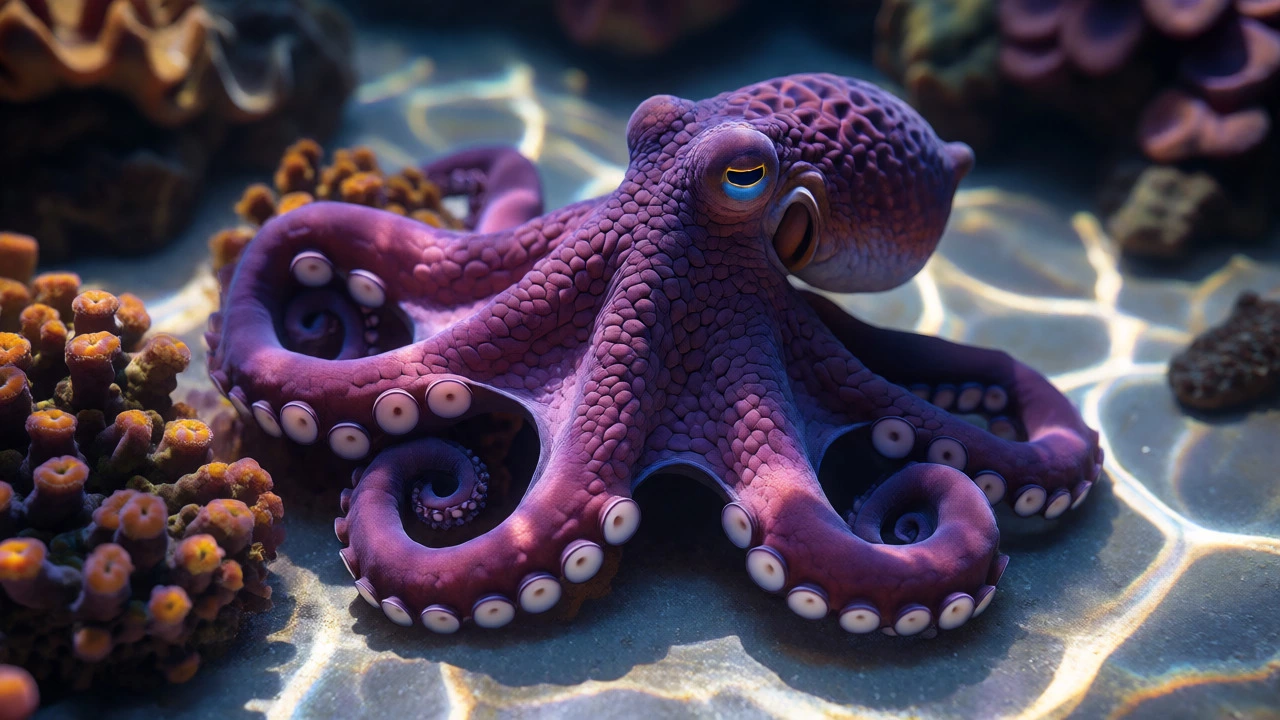
Octopus Plural Quiz
Question 1 of 5
Loading question...
Quiz Complete!
You scored 0 out of 5.
You are at a seafood restaurant. You want to order two grilled octopus tentacles for your appetizer. Or maybe you are writing a sci-fi story where aliens resemble cephalopods. Suddenly, you freeze. Do you say "octopi"? Is that even a word? What about "octopodes"? And what if you just stick with "octopus"?
This linguistic puzzle trips up more people than you might think. It is not just about being grammatically correct; it is about understanding how English absorbs words from other languages and twists them into new shapes. There is no single "right" answer here, but there are definitely better answers depending on who you are talking to. Let's break down the three main contenders: octopuses, octopi, and octopodes.
The Standard Modern Choice: Octopuses
If you want to be safe, clear, and understood by almost everyone in the English-speaking world, use octopuses. This is the standard, accepted plural form in modern English dictionaries, including Merriam-Webster and Oxford. Why? Because English usually forms plurals by adding an "s" or "es" to the end of a noun. We do this for cats, dogs, buses, and yes, octopuses.
Think about it logically. When we borrow a word from Greek or Latin, we don't always keep its original pluralization rules. We've done this for centuries. If you have one forum, you have forums, not fora. If you have one stadium, you have stadiums, not stadia. English speakers naturally gravitate toward the "-es" ending because it follows the phonetic patterns of our language. Saying "octopuses" sounds natural to native speakers because it aligns with how we handle similar words like "campuses" or "gases."
Using "octopuses" shows you understand current usage. It is the most common form found in scientific literature, journalism, and everyday conversation. If you are writing an email to a colleague or ordering dinner, this is your go-to choice. It removes ambiguity. No one will look at you funny. No one will question your education. It simply works.
The Hyper-Correct Trap: Octopi
Now, let's talk about the most controversial option: octopi. Many people believe this is the "proper" plural because they know Latin endings change nouns. They think "-us" becomes "-i," so octopus must become octopi. Sound familiar? It happens with cactus (cacti) and fungus (fungi).
But here is the catch: Octopus is not a Latin word. It comes from Ancient Greek. In Greek, the second declension masculine nouns ending in -os typically form their plural in -oi. So, technically, the Greek plural would be octopodes. The Latin equivalent doesn't exist because Romans didn't have a word for this specific creature. Therefore, applying the Latin rule (-us to -i) is actually a mistake. It is a hypercorrection-trying so hard to be right that you end up wrong.
Despite being etymologically incorrect, "octopi" has gained traction. Some style guides accept it as a valid variant because so many people use it. However, linguists often cringe when they hear it. If you use "octopi," you might sound like someone trying too hard to impress others with their classical knowledge. It is widely used, especially in informal settings, but it lacks the authority of "octopuses." Use it if you want to sound casual or if you are among friends who enjoy debating grammar, but avoid it in formal academic writing.
The Etymological Purist: Octopodes
If you really want to flex your linguistic muscles, there is a third option: octopodes. This is the true plural based on the word's Greek roots. In Ancient Greek, the plural of a noun ending in -pus (from pous) is -podes. Think of tripod becoming tripods. Well, octopus follows a similar pattern.
Pronouncing "octopodes" can be tricky. It is usually pronounced ok-TOP-uh-deez. It sounds sophisticated, ancient, and precise. Scientists and marine biologists sometimes use this term to distinguish themselves from laypeople. If you are writing a paper on cephalopod behavior or giving a lecture at a university, using "octopodes" signals that you respect the etymology of the subject matter.
However, outside of specialized circles, "octopodes" sounds pretentious. Your average person will not know what you are saying. They might think you made the word up. It is rare in everyday speech. You won't hear it at the aquarium gift shop or in a movie script unless the character is meant to be portrayed as a snob or an expert. But for those who care about historical accuracy, it is the most defensible choice from a linguistic standpoint.
| Form | Origin/Rationale | Usage Context | Acceptance Level |
|---|---|---|---|
| Octopuses | Standard English rule (-es) | General, Scientific, Formal | High / Recommended |
| Octopi | False Latin analogy (-us to -i) | Informal, Humorous | Mixed / Debated |
| Octopodes | Greek etymology (-pous to -podes) | Academic, Specialized | Niche / Expert |
| Octopus | Invariant plural (like sheep) | Colloquial, Specific Dialects | Low / Non-standard |
Why Does This Confusion Exist?
English is a thief. It steals words from everywhere. About 60% of English vocabulary comes from Latin and Greek roots. When we steal these words, we sometimes keep their original grammar, and sometimes we ignore it entirely. This inconsistency creates gray areas.
Consider the word "data." Originally, data was the plural of datum in Latin. Today, most people treat data as a singular mass noun, like water or sand. "The data is good" is now acceptable in many contexts, whereas "The data are good" sounds stiff to modern ears. Similarly, "forum" can be "forums" or "fora." Both are correct, but "forums" is overwhelmingly more common.
With octopus, the confusion stems from people recognizing the "-us" ending and assuming it must follow the same rules as cactus or nucleus. They don't check the origin. They apply a pattern they learned in school. This is called analogical leveling-regularizing irregular forms. Language evolves through usage, not just logic. If enough people say "octopi," it eventually becomes accepted, even if it started as a mistake. That is how language works.
When Should You Use Which?
So, which one should you pick? Here is a simple decision tree to help you out.
- Choose "Octopuses" if: You are writing for a general audience, sending an email, teaching a class, or publishing in a mainstream magazine. It is the safest bet. It minimizes friction and maximizes clarity.
- Choose "Octopi" if: You are joking around, writing a children's book, or speaking casually with friends who enjoy wordplay. Just be prepared for a grammar nerd to correct you.
- Choose "Octopodes" if: You are writing a scientific paper, presenting at a biology conference, or trying to emphasize the Greek heritage of the animal. Use it sparingly to maintain impact.
- Avoid "Octopus" as a plural unless you are using it as a collective noun (e.g., "a school of octopus"), though even then, "octopuses" is clearer.
Remember, context matters. In a legal document, precision is key, so stick to the dictionary standard. In a creative story, you might choose "octopodes" to make an alien species sound ancient and mysterious. There is no moral failing in choosing any of these, but there are social consequences to getting it wrong in the wrong room.

Other Tricky Animal Plurals
If you enjoyed this deep dive into octopus plurals, you might appreciate other animals that cause similar headaches. These examples highlight how inconsistent English pluralization can be.
- Cactus: Cacti (Latin) or Cactuses (English). Both are widely accepted, though cacti is preferred in botanical contexts.
- Fungus: Fungi (Latin) or Funguses (English). Fungi is the standard in science.
- Octopus: As discussed, octopuses is best for general use.
- Platypus: Platypuses. Despite the "-us" ending, there is no strong Latin/Greek precedent for "platypi," so English rules win.
- Hippopotamus: Hippopotamuses. Again, the English suffix prevails over the hypothetical "hippopotami."
The trend is clear: English prefers simplicity. Unless the Latin or Greek plural is deeply entrenched in scientific terminology (like fungi or bacteria), the English "-s" or "-es" ending usually wins out in everyday communication. This reduces cognitive load for speakers. We don't need to remember multiple conjugation tables for every borrowed word.
Final Thoughts on Linguistic Flexibility
Language is not static. It changes based on how people use it. Fifty years ago, "octopi" might have been considered strictly incorrect. Today, some dictionaries list it as an alternative. A hundred years from now, "octopodes" might disappear entirely, or "octopi" might become the dominant form. Who knows?
The key takeaway is to match your language to your audience. If you want to communicate efficiently, use "octopuses." If you want to educate or entertain with trivia, bring up "octopi" and "octopodes." Understanding the difference makes you a better communicator. It shows you pay attention to detail. And frankly, it makes you more interesting at parties.
Next time you see eight arms waving in an aquarium tank, you won't hesitate. You'll know exactly what to call them. And if someone argues with you, you can smile, knowing you understand the history behind the word.
Is octopi grammatically correct?
It is widely used and understood, but linguistically inaccurate. Since "octopus" comes from Greek, not Latin, the Latin plural rule (-us to -i) does not apply. However, due to frequent usage, many dictionaries now list it as an acceptable variant, though "octopuses" remains the preferred standard.
How do you pronounce octopodes?
It is pronounced ok-TOP-uh-deez. The stress falls on the second syllable, and the final "es" is pronounced as a "z" sound. It is rarely used in casual conversation, so listeners may find it unfamiliar.
Can I just say octopus for more than one?
Yes, but it is non-standard. Unlike words like "sheep" or "fish," "octopus" is not traditionally an invariant plural. While you might hear it in very casual speech or specific dialects, "octopuses" is much clearer and grammatically safer.
Which plural do scientists use?
Marine biologists and zoologists typically use "octopuses" in general publications. However, in highly technical papers focusing on taxonomy or etymology, you may occasionally see "octopodes" to emphasize the Greek root. "Octopi" is generally avoided in professional scientific writing.
Why is the plural of octopus confusing?
The confusion arises because English borrows words from Latin and Greek but applies different pluralization rules inconsistently. People recognize the "-us" ending and assume it follows the Latin pattern (like cactus/cacti), ignoring the actual Greek origin of the word.