

Getting curtain length right isn’t just about looks-it changes how a room feels. Too short, and the window looks like an afterthought. Too long, and you’re dragging fabric through dust and pets. The sweet spot? It depends on your style, your window, and how much drama you want. Most people guess. Smart people measure.
Standard Curtain Lengths and Where They Fall
There are three go-to curtain lengths that work for 90% of homes. Each creates a different vibe.
- Just above the windowsill - Hangs 1/2 inch to 1 inch above. Best for kitchens, bathrooms, or rooms where you need clear access to the sill. Common in rentals or modern minimalist spaces.
- To the bottom of the window trim - Ends right at the edge of the casing. Clean, tidy, and practical. Works well in offices or children’s rooms where you don’t want fabric getting in the way.
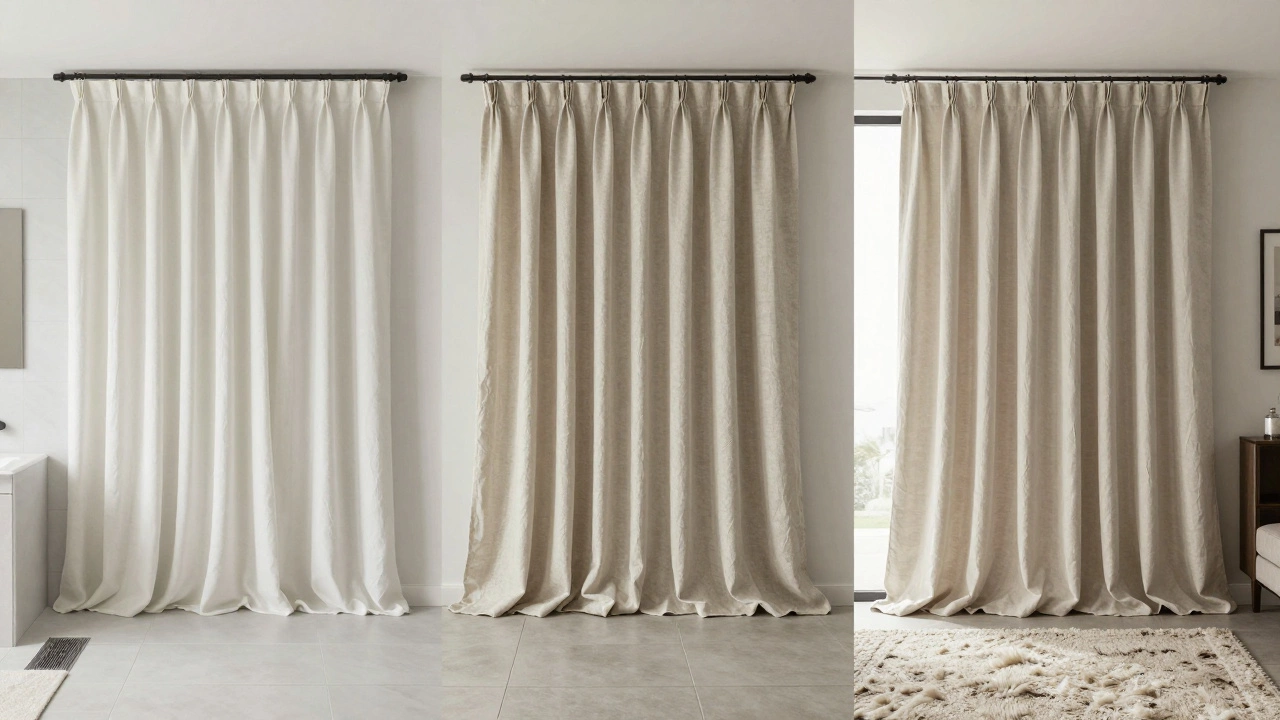
- Just touching the floor - The most popular choice. The curtain stops 1/4 inch above the floor. No pooling, no dragging. Looks intentional, not sloppy.
- Lightly pooling - Drops 1 to 3 inches past the floor. Creates soft folds that look luxurious. Ideal for formal living rooms, bedrooms, or when you’re going for a high-end hotel feel.
- Heavy pooling - Drops 6 inches or more. Rare. Only works in very large rooms with high ceilings and heavy fabrics like velvet or brocade. In most homes, this looks messy, not elegant.
If you’re unsure, start with just touching the floor. It’s the safest, most universally flattering option.
Why Curtain Length Matters More Than You Think
It’s not just about hiding the window frame. Curtain length affects how tall a room feels. Short curtains make ceilings look lower. Long curtains pull the eye upward, making even small rooms feel more spacious.
Look at any home magazine or showroom. The curtains always hit the floor-or almost. That’s not a coincidence. It’s a design trick. When fabric flows from the top of the window all the way down, it creates vertical lines. Vertical lines = taller rooms. It’s basic visual psychology.
Also, think about function. If your curtains drag on the floor, they collect dust, pet hair, and moisture. In a damp bathroom or a busy hallway, that’s a cleaning nightmare. If they’re too short, they look cheap, like they’re hiding something.
How to Measure Correctly (Step by Step)
Don’t eyeball it. Grab a tape measure and follow this.
- Measure from the top of your curtain rod to the floor. Use a metal tape, not a cloth one-they stretch.
- If you’re using a rod that sits above the window frame (recommended), measure from the rod, not the top of the window.
- Decide your desired length: just touching the floor? Add 1/4 inch. Pooling? Add 1 to 3 inches.
- Subtract the height of your curtain rings or tabs. If your rings add 1 inch of drop, subtract that from your total. Otherwise, your curtains will be longer than you expect.
- Write it down. Don’t trust your memory.
Example: Your rod is 84 inches from the floor. You want the curtain to just touch the floor. You’re using 1-inch rings. So you need a curtain that’s 84 + 0.25 - 1 = 83.25 inches. Order 83 inches or 84 inches depending on what the store offers.

What If Your Window Isn’t Standard?
Not every window is a neat rectangle. Here’s how to handle the tricky ones.
- Bay windows - Measure each panel separately. Curtains should hang evenly across all sections. Aim for the same length on each panel, even if the floor drops slightly. Consistency beats perfection.
- Sliding glass doors - Hang the rod 4 to 6 inches above the top of the door. Curtains should still hit the floor. Longer rods help the curtains open fully and look more elegant.
- Windows with radiators - If the radiator is directly under the window, don’t let curtains touch it. Heat rises. Fabric can get hot, fade, or even catch fire. Stop the curtain 2 to 3 inches above the radiator.
- High ceilings - If your ceiling is over 9 feet, go for pooling. 2 to 4 inches of extra fabric adds weight and drama. Don’t be afraid to go long-it’s the only way to balance the scale.
Fabric Matters More Than You Realize
Lightweight cotton or linen? It won’t pool. It’ll just hang straight. That’s fine if you want a breezy, airy look. But if you want soft folds, you need heavier fabric. Velvet, blackout lining, or silk blends have the weight to drape naturally.
Here’s a quick rule: if the fabric is under 8 oz per square yard, it won’t pool. If it’s over 12 oz, it will pool even with minimal extra length. Most store-bought curtains are 10-14 oz. That’s the sweet spot for a little natural drape.
Also, lining changes everything. Unlined curtains hang looser. Lined ones hang tighter and fuller. If you’re ordering custom curtains, always specify if you want lining-and how much extra length you want to account for it.
Common Mistakes (And How to Avoid Them)
- Buying off the rack without measuring - A 96-inch curtain doesn’t mean it hangs 96 inches from your rod. Add the ring height. Subtract the header. Always check the product description for hanging length, not just fabric length.
- Hanging the rod too low - Mounting the rod right above the window makes the room feel cramped. Hang it 4 to 6 inches above the window frame. It opens up the space.
- Ignoring the floor type - Thick rugs? Carpets? Your curtain might look too short if you don’t account for the height of the rug. Measure from the rod to the top of the rug, not the floor.
- Using the same length everywhere - Don’t put long, pooling curtains in a tiny bathroom. Keep it short and practical. Save the drama for the living room.
Real-World Examples from UK Homes
In Bristol, where many homes have sash windows and uneven floors, people often overthink this. Here’s what works:
- Victorian terraces - Tall ceilings, 10-foot windows. Curtains hang 2 inches past the floor. Velvet, lined. Looks grand.
- Modern flats - 8-foot ceilings, minimal frames. Curtains hit the floor with no pool. Linen, unlined. Clean and calm.
- Older cottages - Uneven floors, small windows. Curtains stop 1 inch above the floor. Cotton, with tiebacks. Practical but still pretty.
There’s no single right answer. But there’s a right answer for your space.
Final Rule: When in Doubt, Go Longer
You can always hem curtains down. You can’t easily add length. If you’re choosing between 84 inches and 96 inches, and you’re not sure, pick 96. Take it to a tailor or do it yourself with a needle and thread. It’s easier than ordering new ones.
And if you’re still stuck? Look at your favorite room in a design magazine. Measure the curtains. Copy that. You’ll be surprised how often the same rule applies across styles and countries.
Curly curtains don’t make a room. But the right length? That’s the quiet detail that makes everything else look intentional.
Should curtains touch the floor or hover above?
For most homes, curtains should just touch the floor-about 1/4 inch above. This looks clean and intentional. Hovering too far above (like 2 inches or more) makes the room feel unfinished. Touching the floor adds elegance, but pooling (extra fabric) is only for formal spaces with heavy fabrics.
How much extra length do I need for pooling curtains?
For a soft, elegant pool, add 1 to 3 inches beyond the floor. More than that-like 6 inches or more-only works in very large rooms with high ceilings and thick fabrics like velvet. In small or modern spaces, too much pooling looks messy, not luxurious.
Do I measure from the rod or the top of the window?
Always measure from the curtain rod, not the window frame. Most people install rods 4 to 6 inches above the window to make the space feel taller. If you measure from the window, your curtains will end up too short. The rod is your true starting point.
What if my floor isn’t level?
Measure at the lowest point. If your floor slopes, hang the curtain to the lowest spot. That way, it won’t drag on one side. In older homes, this is common. A slight difference of half an inch won’t be noticeable once the curtains are open or closed.
Can I use the same curtain length for all windows in a room?
Yes, and you should. Consistency creates calm. Even if your windows are different sizes, keep the curtain length the same. This unifies the space visually. Only vary the length if you’re going for a deliberate design contrast-like short curtains in a kitchen and long ones in the bedroom.