
Two-Way Mirror Detection Tool
🔍 Interactive Mirror Safety Check
Follow this step-by-step guide to determine if a mirror might be two-way. Answer questions about your observations to get a risk assessment.
Step 1: The Nail Test
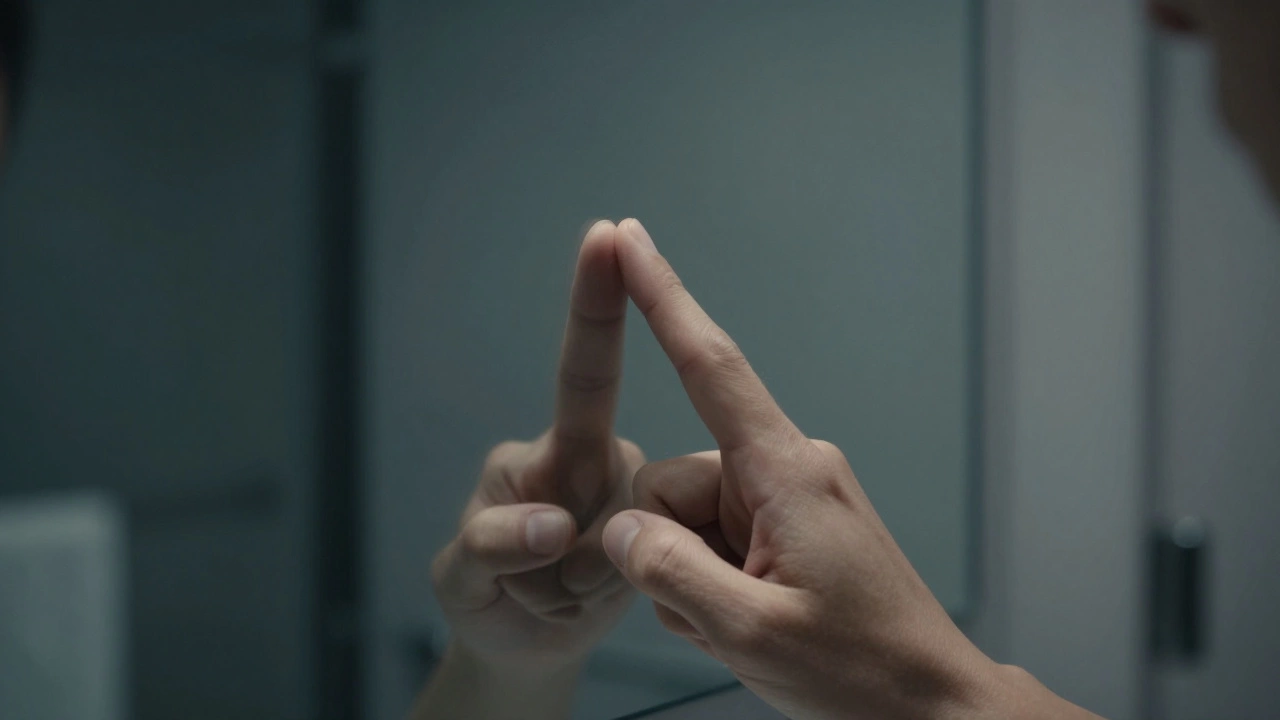
Press your fingernail firmly against the center of the mirror. Look closely at where your nail meets its reflection.
Step 2: The Light Test
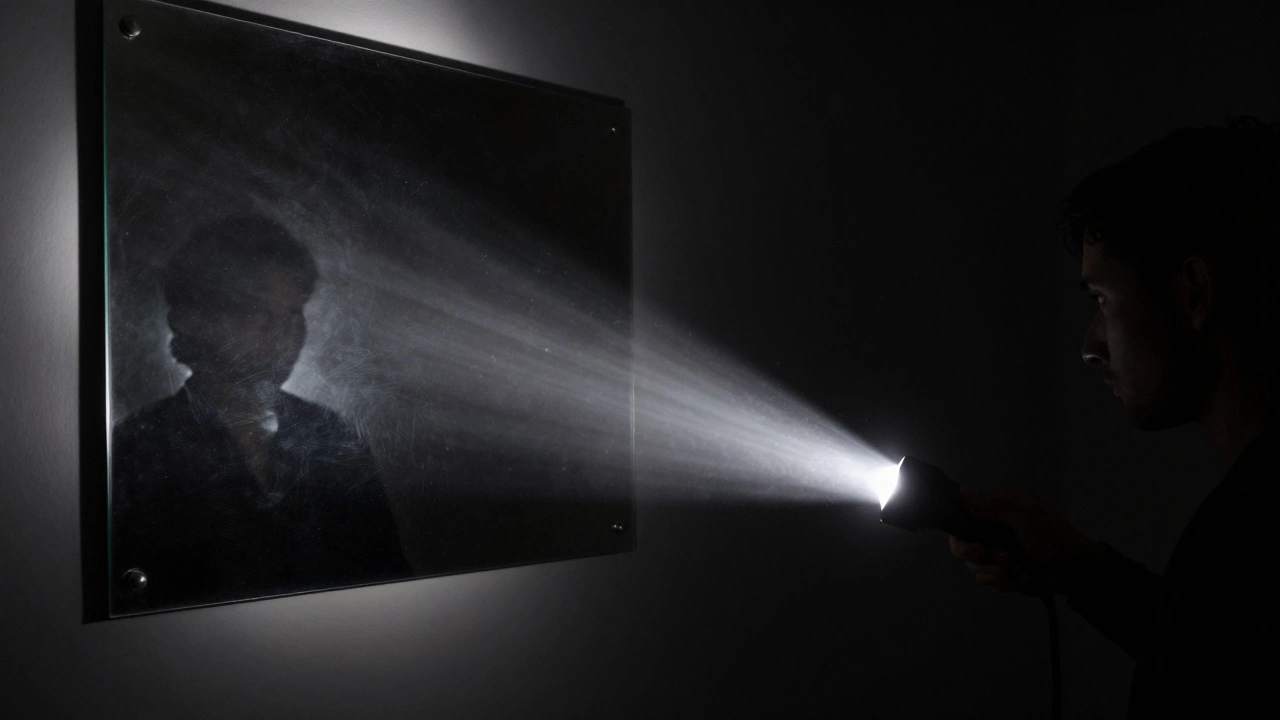
Turn off all lights in the room. Press a bright flashlight directly against the mirror surface and look through it.
Step 3: Camera & IR Scan
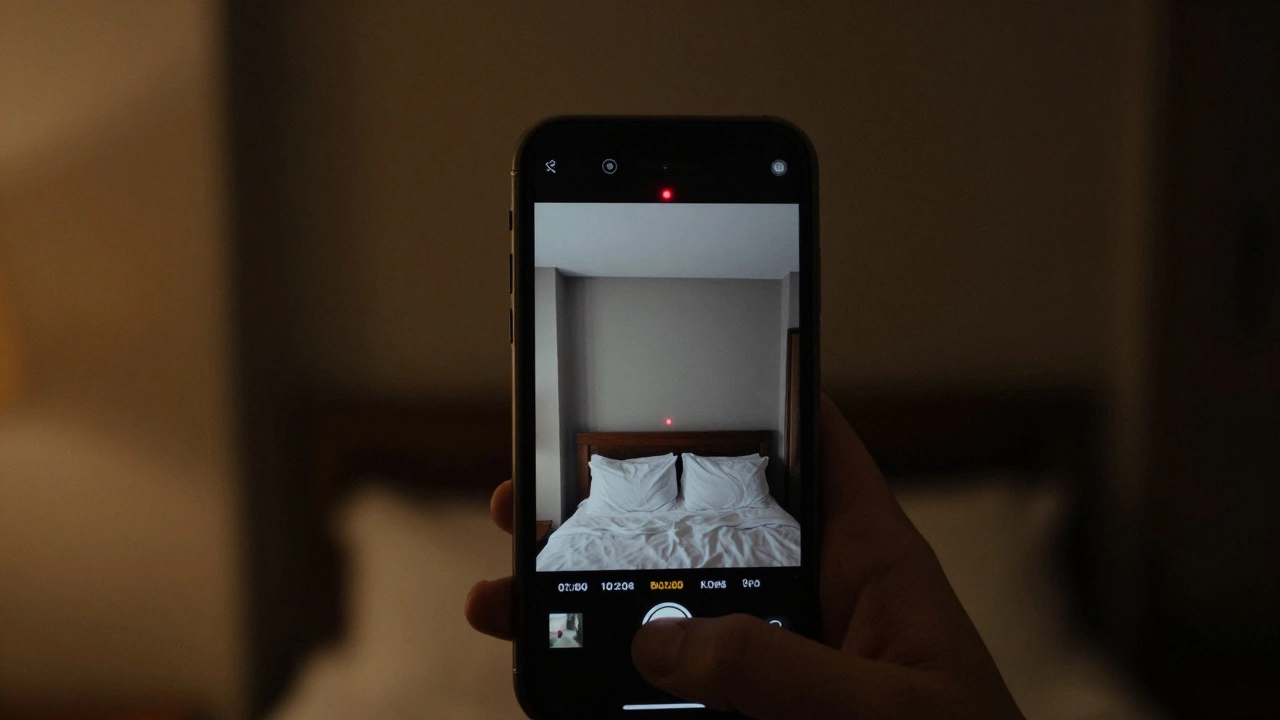
Turn off all lights. Use your phone's camera to scan the mirror and surrounding area for small red or purple dots (IR LEDs).
Step 4: Physical Inspection
Tap the mirror gently with your knuckle. Check the frame edges for gaps, warmth, or loose screws.
Your Risk Assessment
There is a specific kind of unease that comes from staring into a reflection. It’s not just vanity; it’s the primal question of what lies behind the glass. You might have seen this in movies-a detective tapping on a bathroom wall or pressing a fingernail against the surface to check for a gap. But does that trick actually work? And more importantly, if you are staying in an Airbnb, using a public restroom, or simply renovating your home, how do you know you aren’t being watched?
The short answer is yes, there are ways to tell if a mirror is real or if it is a two-way mirror (also known as a one-way mirror) designed to let someone see through it. However, the internet is full of myths. The "finger gap" test is the most famous, but it is scientifically flawed. To truly protect your privacy, you need to understand the physics of light, the construction of mirrors, and the subtle signs of surveillance technology.
The Physics Behind the Glass: How Mirrors Work
Before we get to the tests, you need to understand what you are looking at. A standard household mirror is made of glass with a reflective coating-usually silver or aluminum-applied to the back. This coating is then protected by a layer of paint or primer. When light hits this surface, about 90% to 95% of it bounces back to your eyes. That is why your reflection is bright and clear.
A two-way mirror works differently. It has a semi-reflective coating applied to the front of the glass, not the back. This coating allows some light to pass through while reflecting some light back. For the illusion to work, the room on your side must be brightly lit, while the room on the other side must be pitch black. If the lighting conditions change-if the dark room turns on a light-the magic disappears, and people on both sides can see each other.
This distinction is crucial because it changes how the mirror behaves under stress tests. A real mirror blocks almost all light from passing through. A two-way mirror lets light leak through. Your goal is to detect that leakage.
Debunking the Myth: Why the Finger Gap Test Fails
You have likely heard this one: place your fingertip against the mirror. If there is a gap between your finger and its reflection, it is a real mirror. If your finger touches its reflection directly, it is a two-way mirror. Sounds simple, right? Unfortunately, it is wrong.
The gap you see in a real mirror is not proof of authenticity; it is proof of thickness. Standard mirrors have glass that is several millimeters thick. Light travels through the glass, reflects off the back coating, and travels back out. This distance creates a small visual offset between your physical finger and the virtual image. In a two-way mirror, the reflective coating is on the front surface. Therefore, the reflection appears to touch your finger immediately.
Here is the catch: many high-quality decorative mirrors and antique mirrors also have coatings on the front or use very thin glass. Conversely, some cheap two-way mirrors might be mounted with spacers that create a false gap. Relying solely on the finger test can give you a false sense of security. It is a good starting point, but never the final verdict.
The Nail Test: A More Reliable Indicator
If the finger test is unreliable, what is better? Try the nail test. Press the tip of your fingernail firmly against the center of the mirror. Look closely at the junction where your nail meets the reflection.
- Real Mirror: You will see a distinct space between the tip of your nail and the tip of the reflected nail. This is due to the depth of the glass and the rear-mounted coating.
- Two-Way Mirror: The tip of your nail will appear to touch the tip of the reflected nail directly, with no visible gap. This indicates the reflective surface is on the front of the glass.
While still subject to glass thickness variations, the nail test is generally more precise than the finger test because nails are thinner and allow for a more direct line of sight to the surface interface. However, like the finger test, it is not foolproof against specialized optical glass.
The Light Test: The Gold Standard for Detection
The most reliable way to determine if a mirror is two-way is to manipulate the light. Remember the rule: two-way mirrors require a bright room on your side and a dark room on the other side to function as a mirror. If you reverse this dynamic, the mirror fails.
Here is how to perform the light test:
- Turn off all lights: Go into the room with the mirror and turn off every light source. Close curtains or blinds to block external daylight. The room should be as dark as possible.
- Use a flashlight: Take a strong LED flashlight (or your phone’s torch) and press it directly against the surface of the mirror. Cover the edges of the flashlight with your hand to prevent light from leaking around the device.
- Observe the reflection: Shine the light into the mirror. If the mirror is real, you will see only your own face illuminated by the flashlight. The glass will remain opaque.
- Look for transparency: If the mirror is two-way, the intense light from your flashlight will penetrate the semi-transparent coating. You may be able to see shadows, objects, or even movement in the room behind the mirror. The mirror will look less like a mirror and more like a window.
This test exploits the fundamental weakness of two-way glass: it is not truly reflective; it is merely partially transparent. By overpowering the ambient light with a focused beam, you force the glass to reveal its true nature.
Checking for Hidden Cameras and Sensors
In modern scenarios, especially in short-term rentals or hotel rooms, the concern isn't just a two-way mirror-it's the camera on the other side. Even if you confirm the mirror is real, a camera could be hidden nearby. Here is what to look for.
First, inspect the frame. Two-way mirrors often require thicker frames to hide the mounting hardware and wiring for cameras. Run your fingers along the edges. Do you feel any unusual gaps, loose screws, or warm spots? Electronics generate heat. If a section of the mirror frame feels warmer than the rest, it might house a circuit board.
Second, look for lens glints. Use your phone camera to scan the mirror and surrounding area. Many older digital cameras have infrared LEDs that emit a faint red or purple glow visible to smartphone sensors but invisible to the naked eye. Turn off the lights again, open your camera app, and slowly pan across the mirror. Look for small, blinking dots.
Third, check for audio devices. Small pinhole microphones can be embedded in smoke detectors, air vents, or even the mirror frame itself. Listen for static or humming sounds when the room is silent. Tap lightly on the mirror. A hollow sound might indicate a cavity behind the glass where equipment could be stored.
Signs of Professional Installation vs. DIY Hacks
Not all suspicious mirrors are professionally installed spy gear. Sometimes, landlords or previous tenants install cheap acrylic sheets or plastic mirrors to save money. These materials behave differently than glass.
Tap the mirror gently with your knuckle. Real glass produces a sharp, high-pitched "ping." Plastic or acrylic produces a duller, lower-thumped sound. While this doesn't prove surveillance, it suggests the mirror might not be up to code or might be hiding something else.
Also, examine the edges. Professional two-way mirrors are usually cut precisely and fitted flush with the wall. DIY installations often leave visible gaps, uneven caulking, or misaligned tiles. If the mirror looks slightly askew or if the grout lines don't match the surrounding pattern, investigate further.
What to Do If You Suspect a Two-Way Mirror
If your tests suggest the mirror is two-way, do not panic. First, document everything. Take photos and videos of the mirror, the room, and any anomalies you found. Note the time, date, and location.
If you are in a rental property, contact the host or landlord immediately. Ask them to explain the mirror's purpose. If they cannot provide a satisfactory answer, or if you feel unsafe, leave the premises. Do not confront anyone who might be watching. Your safety is the priority.
If you are in a public space, such as a gym locker room or a restaurant, report your concerns to management. Most legitimate businesses will remove the mirror or cover it with a decal to alleviate customer fears. Privacy laws vary by region, but in many places, recording individuals in private spaces without consent is illegal.
Prevention and Peace of Mind
For homeowners, preventing unauthorized viewing is easier than detecting it. If you are installing new mirrors, choose standard rear-coated glass. Avoid buying second-hand mirrors from unknown sources unless you have inspected them thoroughly.
If you suspect a mirror in your own home has been tampered with, consider replacing it. There is no cost-effective way to "convert" a two-way mirror back into a standard mirror without removing the glass entirely. Painting over the back of a two-way mirror won't work because the coating is on the front. The only solution is replacement.
Finally, trust your instincts. If a mirror feels wrong-if the reflection seems dim, distorted, or if the room layout doesn't make sense-investigate. Technology is advancing, but basic physics remains constant. Light, shadow, and reflection are tools you can use to uncover the truth.
Is the finger gap test accurate for detecting two-way mirrors?
No, the finger gap test is not fully accurate. While it often shows a gap for real mirrors and no gap for two-way mirrors, the result depends on glass thickness and coating placement. Some real mirrors have thin glass or front coatings that eliminate the gap, leading to false positives. It should be used as a preliminary check, not a definitive test.
How does the light test work for two-way mirrors?
The light test involves turning off all room lights and shining a bright flashlight directly against the mirror surface. If the mirror is two-way, the intense light will penetrate the semi-transparent coating, allowing you to see through to the other side. Real mirrors will remain opaque regardless of the light intensity.
Can I use my phone camera to detect hidden cameras behind a mirror?
Yes, in some cases. Many hidden cameras use infrared LEDs for night vision, which emit a faint glow visible to smartphone cameras but not the naked eye. Turn off the lights, open your phone's camera app, and scan the mirror for small red or purple dots. Note that newer cameras may not use IR LEDs, so this method is not foolproof.
What is the difference between a real mirror and a two-way mirror?
A real mirror has a reflective coating on the back of the glass, blocking nearly all light from passing through. A two-way mirror has a semi-reflective coating on the front, allowing some light to pass through. Two-way mirrors require specific lighting conditions (bright on one side, dark on the other) to function as mirrors; otherwise, they act as windows.
Should I be worried about two-way mirrors in hotels or Airbnbs?
While rare, incidents of hidden cameras and two-way mirrors in rentals have occurred. It is wise to perform quick checks, such as the light test and visual inspection, upon arrival. If you find anything suspicious, document it and contact the host or platform immediately. Trust your instincts and prioritize your safety.