
Infinite Mirror Reflection Simulator
How it works: Each time light reflects off a mirror, some energy is absorbed. With 95% reflectivity, after just 50 bounces, less than 0.1% of the original brightness remains. This exponential decay is why you typically see only 20-40 distinct images in household mirrors before they fade into darkness.
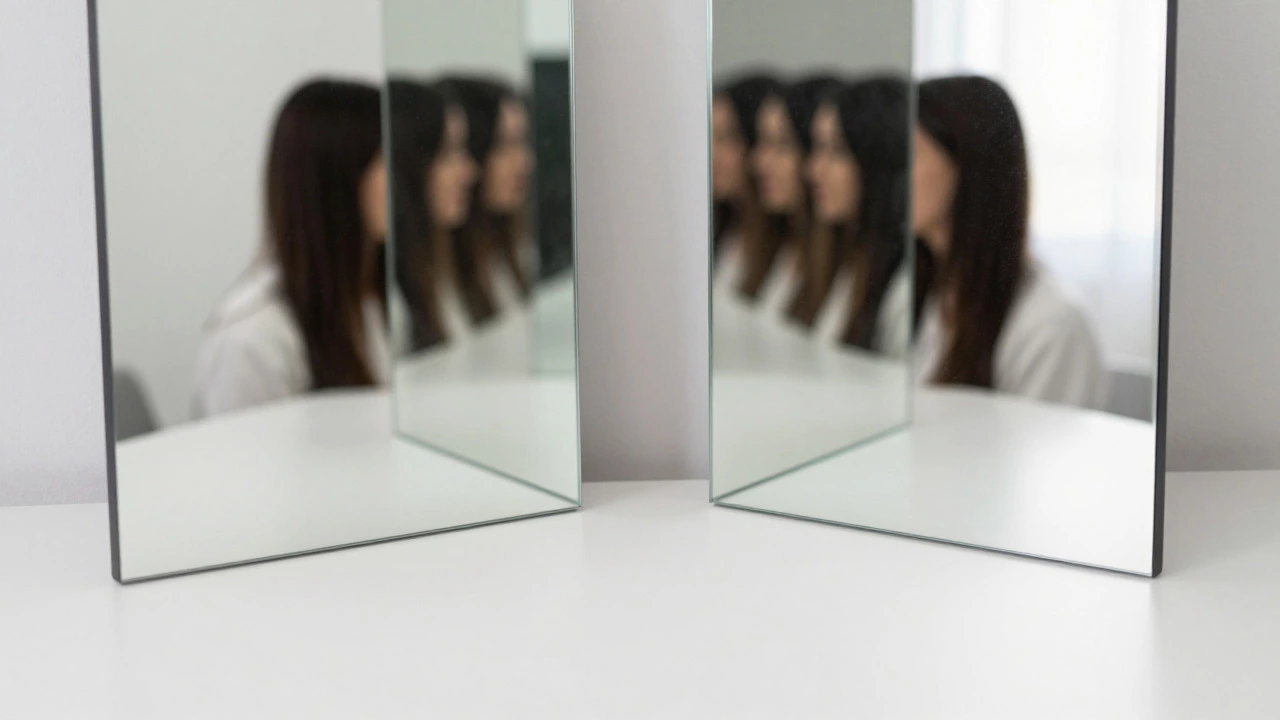
Stand in front of a bathroom mirror. Now, grab another one and place it so the reflective surfaces face each other. Look closely at the edge where they meet. What you see is not just a reflection; it’s a tunnel stretching back into what looks like forever. It feels like a glitch in reality, a visual loop that defies logic. But this phenomenon isn’t magic or science fiction-it’s pure optics.
The "infinite mirror" effect happens because light bounces back and forth between two parallel surfaces. Each bounce creates a new image, slightly dimmer and smaller than the last. While it looks endless to our eyes, physics puts a hard limit on how far those reflections can actually go. Understanding why this happens reveals fascinating truths about how we perceive depth, how light behaves, and the limits of human vision.
The Mechanics of Bouncing Light
To understand the infinite corridor, you first need to look at what a mirror actually does. A standard household mirror consists of glass with a thin layer of aluminum or silver backing. When light hits this surface, it doesn’t absorb the photons; it reflects them. This is called specular reflection, meaning the light bounces off at the same angle it arrived, preserving the image clearly.
When you place two mirrors facing each other perfectly parallel, you create a closed loop for light rays. Here is the step-by-step process:
- Initial Reflection: Light from your face hits Mirror A and bounces to Mirror B.
- Secondary Reflection: That light hits Mirror B and bounces back to Mirror A.
- Tertiary Reflection: The light hits Mirror A again and bounces back to Mirror B.
- Repetition: This cycle repeats thousands of times in a fraction of a second.
Each time the light travels between the mirrors, it creates a virtual image behind the glass. Your brain interprets these layered images as objects receding into the distance. Because the mirrors are parallel, the geometry remains consistent, creating that straight, tunnel-like perspective. If the mirrors were angled even slightly, the tunnel would curve or spiral instead.
Specular Reflection is the mirror-like reflection of light, such as from a smooth surface, where light from a single incoming direction is reflected into a single outgoing direction.. This differs from diffuse reflection, which scatters light in many directions, like light hitting a piece of paper.Why the Tunnel Doesn't Actually Go On Forever
If you stare deep enough into the mirror tunnel, you’ll notice something odd. The images don’t stay bright and crisp. They get darker, fuzzier, and eventually disappear into blackness. Why? Because no mirror is perfect.
Every time light reflects off a mirror, some energy is lost. Standard household mirrors reflect about 90% to 95% of the light that hits them. The rest is absorbed by the glass or the metal backing. Let’s do the math. If a mirror reflects 95% of light:
- After 1 bounce: 95% brightness remains.
- After 10 bounces: About 60% brightness remains.
- After 50 bounces: Less than 1% brightness remains.
- After 100 bounces: The light is virtually non-existent.
This exponential decay means that after roughly 30 to 50 reflections, the image becomes too dark for the human eye to detect. In a typical room, the "infinite" tunnel usually ends after seeing about 20 to 30 distinct images before fading into darkness. High-quality optical mirrors used in laboratories can reflect up to 99.9% of light, allowing for hundreds more visible reflections, but even they aren’t truly infinite.
| Mirror Type | Reflectivity | Visible Reflections (Est.) | Primary Use |
|---|---|---|---|
| Household Glass Mirror | 90-95% | 20-40 | Bathrooms, Decor |
| First-Surface Optical Mirror | 99-99.9% | 100+ | Laser Cavities, Telescopes |
| Dielectric Mirror | >99.99% | Thousands | Precision Lasers |
The Role of Imperfections and Distortion
Beyond light loss, physical imperfections play a huge role in what you see. Most people assume their bathroom mirror is perfectly flat, but mass-produced mirrors often have slight warping. This is known as "potting" or convex/concave distortion.
If the mirrors are not perfectly parallel, the reflections will shift position with each bounce. Instead of a straight tunnel, you might see the images drift to the left or right, or appear to stretch and compress. This is why DIY infinite mirror boxes often require precise alignment tools. Even a millimeter of tilt changes the entire geometric outcome.
Dust, scratches, and fingerprints also degrade the image. Each reflection passes through the glass twice (once entering, once exiting). Any defect on the glass surface gets replicated and magnified in every subsequent reflection. By the 10th or 15th image, minor smudges can look like major clouds obscuring the view.
How Your Brain Interprets the Illusion
The infinite mirror effect is a powerful demonstration of how our brains construct reality. We rely on cues like size constancy and linear perspective to judge distance. In the mirror tunnel, each successive reflection appears smaller because it represents an object further away in the virtual space. Your brain assumes these smaller images are actual objects receding into depth.
This triggers a psychological response known as Réseau Vertigo, or a sensation of dizziness or disorientation caused by looking down or into a seemingly bottomless void.. Standing in front of two facing mirrors can induce mild vertigo in some people because the visual system struggles to anchor itself. There is no horizon line, no clear reference point for "up" or "down," and the depth cue suggests an impossible distance.
Interestingly, children often find this effect more confusing than adults. Younger brains are still developing spatial awareness and may struggle to reconcile the fact that the "tunnel" has no physical end. This makes the mirror setup a useful tool in developmental psychology studies regarding depth perception.
Real-World Applications of Parallel Mirrors
This isn’t just a parlor trick. Scientists and engineers use the principles of parallel mirrors in critical technologies.
Laser Technology: The core component of a laser is an optical cavity made of two highly reflective mirrors facing each other. Light bounces back and forth, amplifying with each pass until it escapes as a coherent beam. Without the high-reflectivity mirrors discussed earlier, lasers wouldn’t work.
Foucault Knife-Edge Test: Opticians use a similar setup to test the curvature of telescope mirrors. By analyzing the patterns of light reflecting between surfaces, they can determine if a mirror is perfectly spherical or parabolic.
Infinite Mirror Art Installations: Artists like Yayoi Kusama use LED lights placed between two-way mirrors to create immersive rooms that appear to extend infinitely. These installations exploit the same physics we discussed but control the lighting to prevent the rapid fade-out seen in household mirrors.
Common Misconceptions About Infinite Mirrors
There are several myths surrounding this phenomenon that deserve debunking.
Myth 1: The reflections go on forever. As explained, light absorption stops the chain. Even in a vacuum with perfect mirrors, quantum effects would eventually disrupt the coherence, though this is theoretical. In practice, entropy wins.
Myth 2: You can see yourself from the past. Some pop-science articles claim that because light takes time to travel, you are seeing delayed versions of yourself. While technically true, the delay is negligible. Light travels at 300,000 kilometers per second. In a 1-meter gap between mirrors, the round trip takes roughly 6.7 nanoseconds. You would need billions of reflections to see a delay of one second, long before the light faded out completely.
Myth 3: It’s dangerous to look into them. Unless you’re staring directly into a high-powered laser cavity, there is no physical danger. However, prolonged staring can cause eye strain due to the lack of focal points. Your eyes constantly try to adjust focus on the "distant" images, leading to fatigue.
Creating Your Own Infinite Mirror Effect
You can recreate this effect at home with minimal cost. Here is a simple guide:
- Gather Materials: Two identical mirrors (preferably frameless for best results), a level, and a clean cloth.
- Clean Thoroughly: Remove all dust and fingerprints. Use glass cleaner and a microfiber cloth. Dust is the enemy of clarity.
- Align Carefully: Place the mirrors on a flat table. Stand them upright using books or stands. Ensure they are exactly parallel. Use a carpenter’s level to check vertical alignment.
- Add Lighting: Place a small LED light source near the opening. Dark rooms make the effect harder to see because there isn’t enough initial light to bounce.
- Observe: Look from the side, slightly above the plane of the mirrors. You should see the tunnel forming. Adjust the angle slightly to center the view.
For a more permanent installation, artists often use two-way mirrors (glass coated with a semi-transparent metallic film) on both sides. This allows light to enter and exit more evenly, creating a brighter, more stable illusion.
Can you really see infinity in two mirrors?
No. While the effect looks infinite, light absorption limits the number of visible reflections. Typically, you can see 20 to 50 distinct images before they fade into darkness due to energy loss in the glass and metal coating.
Why do the reflections get darker?
Each mirror absorbs a small percentage of light (usually 5-10%) during reflection. After multiple bounces, this cumulative loss reduces the brightness exponentially until the image is too faint for the human eye to detect.
Do the mirrors need to be perfect?
Not perfect, but parallel. If the mirrors are tilted, the tunnel will curve or distort. Warped mirrors will cause the images to stretch or shrink unnaturally. Cleanliness is also crucial, as dust magnifies with each reflection.
Is it safe to stare into infinite mirrors?
It is physically safe for standard mirrors. However, it can cause eye strain or mild vertigo because your brain struggles to process the lack of depth cues. Avoid doing this if you are prone to migraines or seizures triggered by visual patterns.
How are lasers related to this effect?
Lasers use an optical cavity with two highly reflective mirrors facing each other. Light bounces back and forth, gaining intensity with each pass, similar to the mirror tunnel but with much higher reflectivity and controlled amplification.