
Luxury Rug Knot Count Calculator
Rug Specifications
Results
Total knots in your luxury rug
Estimated production time based on 10,000 knots per day
Luxury rugs typically have 100-500 knots per square inch. A higher knot count means more intricate patterns, finer details, and longer production time.
A luxury rug isn’t just a floor covering-it’s a piece of art that’s been woven by hand, often over months or even years. Unlike mass-produced rugs you find in big-box stores, a true luxury rug carries history, craftsmanship, and materials that can last generations. If you’ve ever run your fingers over a rug that feels impossibly soft, seen its colors shift in the light, or noticed the intricate patterns that seem to tell a story, you’ve felt the difference. But what exactly makes a rug luxury? It’s not just the price tag. It’s the details most people never see.
What Defines a Luxury Rug?
A luxury rug is defined by four core elements: materials, craftsmanship, origin, and design complexity. These aren’t optional extras-they’re the baseline. You won’t find a true luxury rug made with synthetic fibers like polyester or acrylic. Instead, you’ll see natural fibers: wool, silk, cotton, or sometimes even goat hair or bamboo silk. Wool from New Zealand or Tibet is prized for its durability and natural luster. Silk, often used for fine details, gives the rug a luminous sheen and allows for incredibly tight knots.
The knot count is the most telling metric. A luxury rug typically has between 100 and 500 knots per square inch. The higher the count, the finer the pattern and the longer it took to make. A 9x12 rug with 300 knots per square inch could contain over 38 million individual knots. That’s not a marketing claim-it’s a fact you can verify by counting the knots along an inch of the rug’s edge. Fewer than 80 knots per square inch? That’s not luxury. That’s machine-made.
Hand-Knotted vs. Machine-Made: The Real Difference
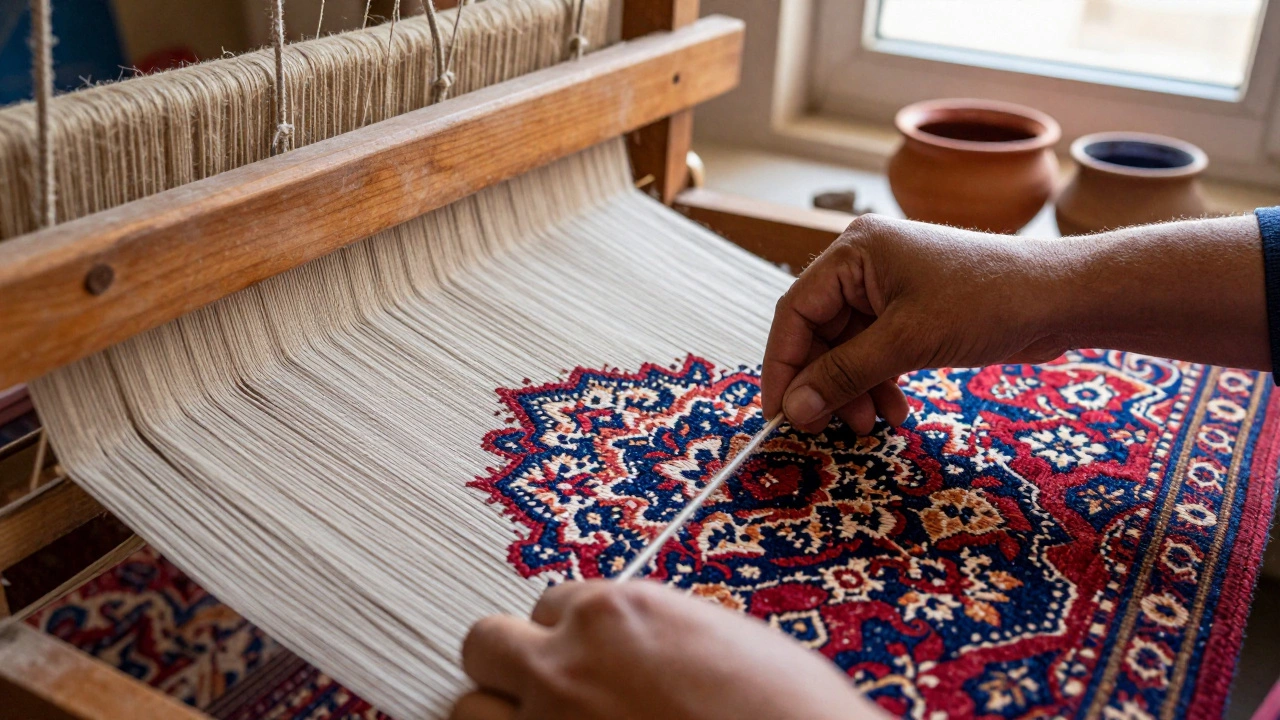
Every luxury rug is hand-knotted. That means a weaver sits at a loom, tying each knot by hand, one at a time. This process can take anywhere from three months to over a year, depending on size and complexity. In contrast, machine-made rugs are produced in hours using automated looms. The difference isn’t just time-it’s soul.
Look closely at the back of a hand-knotted rug. You’ll see the same pattern as the front, slightly faded. That’s because every knot is tied individually. On a machine-made rug, the back is flat and smooth, often with a mesh backing glued on. That glue breaks down over time, causing the rug to peel or shed. A hand-knotted rug, if cared for, will only get better with age.
Real luxury rugs also have fringes that are an extension of the warp threads-never sewn on. If you see stitched-on fringes, it’s not hand-knotted. It’s a trick used to mimic the look without the labor.
Where Do Luxury Rugs Come From?
While you can find hand-knotted rugs made in many places, the most respected come from specific regions with centuries-old traditions. Persian rugs from Iran, especially those from Isfahan, Kashan, or Tabriz, are legendary for their symmetry and color depth. Turkish rugs, particularly from Hereke and Uşak, are known for bold geometric designs and dense wool. Afghan and Caucasian rugs offer bolder, tribal patterns, often dyed with natural pigments.
Indian rugs, especially from Jaipur and Agra, have become major players in the luxury market, often blending Persian techniques with local motifs. Nepal and Tibet produce rugs with thick, lofty wool that’s incredibly durable. Each region has its own signature style, dye recipes, and knotting techniques. A rug’s origin tells you not just where it was made, but how it was meant to be lived with.
Materials That Set Luxury Apart
Wool is the backbone of most luxury rugs. It’s naturally stain-resistant, fire-retardant, and retains color brilliantly. But not all wool is equal. The finest comes from sheep raised in high-altitude, cold climates-like the Himalayas or New Zealand-where the fibers are longer and stronger.
Silk is used sparingly, often for highlights or fine details. A silk rug can cost five times more than a wool rug of the same size because silk is harder to work with and more fragile. But when done right, it catches light like no other material. Some rugs mix wool and silk in a technique called ‘silk accents,’ where the design’s fine lines are rendered in silk while the background is wool. This gives you the best of both: durability and brilliance.
Some high-end rugs use cotton for the foundation. Cotton is strong and stable, making it ideal for the warp and weft threads that hold the knots in place. You’ll rarely see cotton on the surface-it’s hidden, but essential. Natural dyes, made from plants, insects, or minerals, are another hallmark. Indigo, madder root, and walnut shells create colors that fade gracefully over time, developing a soft patina. Synthetic dyes, while cheaper and more consistent, look flat and lifeless in comparison.
Design and Symbolism: More Than Just Patterns
Luxury rugs aren’t random patterns. They’re often loaded with meaning. Persian rugs might feature floral motifs representing paradise, or medallions symbolizing the sun. Tribal rugs from the Caucasus use geometric shapes that tell stories of family, protection, or fertility. A Bokhara rug’s repeating octagon pattern is called a ‘gul’-each one unique to a tribe or village.
Modern luxury rugs still honor tradition but often reinterpret it. Designers now collaborate with weavers to create abstract compositions, minimalist grids, or even custom portraits woven into wool and silk. The best of these keep the handcrafted integrity while speaking to contemporary spaces. A luxury rug doesn’t have to look ‘old-world’ to be valuable. It just has to be made with intention.
Why Do They Cost So Much?
A 6x9 hand-knotted wool and silk rug can easily cost $10,000 to $50,000. That seems outrageous until you break it down. Let’s say a weaver ties 10,000 knots per day. For a rug with 300 knots per square inch, that’s about 1.5 million knots total. At 10,000 knots a day, that’s 150 days of work-nearly five months. That doesn’t include the time spent sourcing wool, spinning it, dyeing it with natural pigments, designing the pattern, and finishing the piece.
And the weaver? They’re not paid minimum wage. In Iran or Nepal, master weavers earn what’s considered a living wage in their region-often more than local doctors or teachers. When you buy a luxury rug, you’re not just paying for materials. You’re paying for skill, time, and cultural heritage.
Compare that to a $300 machine-made rug from a warehouse store. It’s made in a factory in China or Turkey, using synthetic fibers, printed designs, and glue. It might look fine for a year or two, but it won’t last. It won’t hold its color. It won’t gain character. And when it wears out, it goes to landfill.

How to Spot a Real Luxury Rug
Here’s how to tell if a rug is truly luxury:
- Check the back. If the pattern is clear and matches the front, it’s hand-knotted.
- Look at the fringe. It should be part of the rug’s structure, not stitched on.
- Feel the pile. Luxury rugs have a dense, springy texture. Press your hand down-it should bounce back slowly.
- Smell it. Natural fibers and dyes have a faint, earthy scent. Synthetic rugs smell chemical or plastic.
- Ask for the knot count. Reputable sellers will provide it. If they don’t know, walk away.
- Look for slight imperfections. Handmade means human-made. Tiny variations in color or pattern aren’t flaws-they’re proof of authenticity.
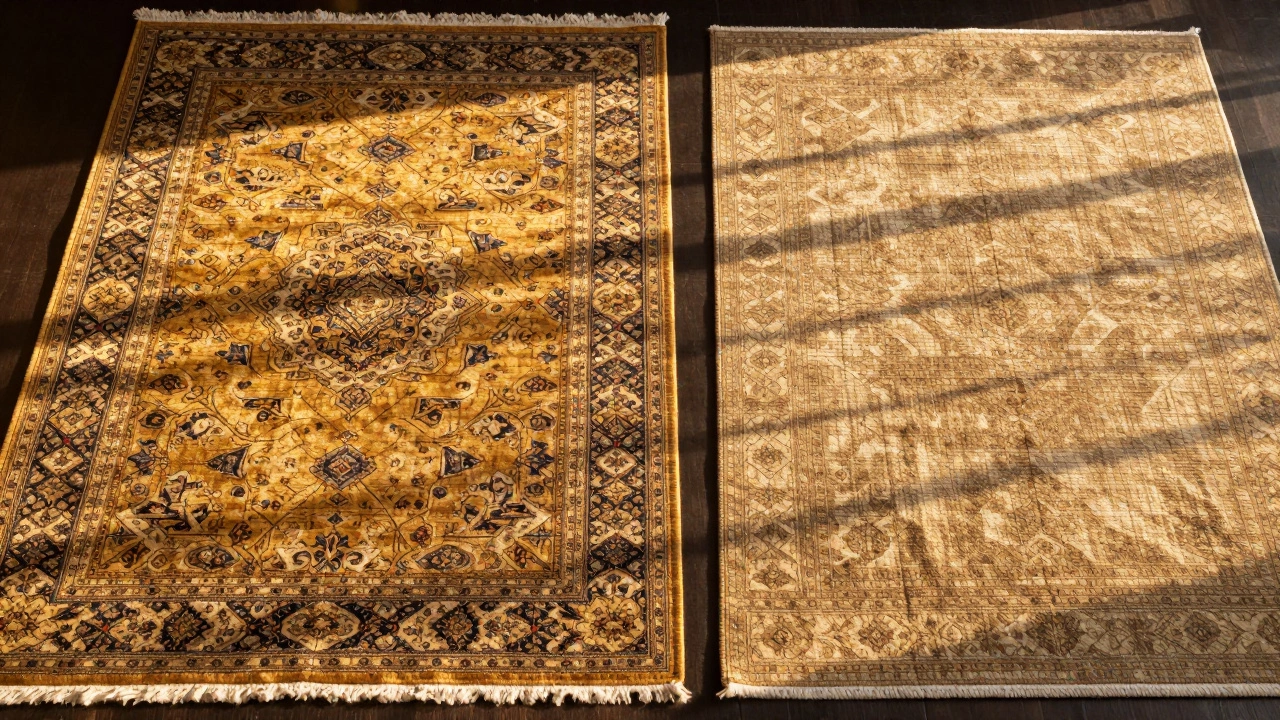
And never buy a luxury rug without seeing it in person if you can. Photos lie. Light changes how colors appear. A rug that looks rich online might look dull in your living room. Trust your eyes, your hands, and your instincts.
What to Do With a Luxury Rug
A luxury rug isn’t meant to be hidden under furniture. Let it breathe. Place it in a high-traffic area like a living room or dining room. The natural oils from walking on it help preserve the fibers. Vacuum weekly with a suction-only setting-never a beater bar. Rotate it every year to even out wear. If it gets stained, don’t reach for harsh cleaners. Use a damp cloth and mild soap. Professional cleaning every 5-7 years is enough.
Think of it like fine furniture. You don’t cover your mahogany table with a plastic sheet. You enjoy it. A luxury rug is the same. It’s meant to be lived on, to age gracefully, and to become part of your home’s story.
Is a Luxury Rug Worth It?
If you’re looking for something to replace every five years, then no. But if you want something that will outlast your children, that adds warmth, artistry, and value to your home-then yes. A true luxury rug doesn’t depreciate. It appreciates. Some Persian rugs from the 1800s sell for millions today. Even modern hand-knotted rugs hold their value far better than any other home decor item.
It’s not just about owning something expensive. It’s about owning something that was made with care, by hands that knew the weight of tradition. That’s rare. And in a world of disposable things, that’s priceless.
Can a luxury rug be cleaned at home?
You can do light spot cleaning at home with a damp cloth and a drop of mild soap, but never use steam cleaners or harsh chemicals. For deep cleaning, hire a professional who specializes in hand-knotted rugs. They use pH-balanced solutions and gentle techniques that won’t damage the fibers or dyes.
Do luxury rugs fade over time?
Natural dyes fade slowly and beautifully, developing a soft patina that adds character. Synthetic dyes fade unevenly and look dull. To protect your rug, avoid direct sunlight for long periods. Use UV-filtering window film if needed. A well-cared-for luxury rug will look richer, not worn out, after decades.
Are silk rugs practical for high-traffic areas?
Pure silk rugs are delicate and best suited for low-traffic spaces like bedrooms or formal living rooms. However, many luxury rugs use silk only for highlights, with wool as the base. These are durable enough for living rooms and dining areas. Always ask what percentage of the rug is silk-anything over 30% should be treated with extra care.
How do I know if a rug is authentic and not a replica?
Look for documentation-reputable dealers provide certificates of authenticity that include the knot count, materials, origin, and weaver’s name. Ask to see the back of the rug. Machine-made rugs have a uniform, printed backing. Hand-knotted rugs show the knot structure clearly. Also, check for slight irregularities in the pattern. Perfection is a red flag.
Can I buy a luxury rug online?
Yes, but be cautious. Only buy from dealers who offer a generous return policy (at least 30 days), high-resolution photos of the rug’s front and back, and clear details on materials and knot count. Avoid sites that only show flat, studio-lit images. A luxury rug’s texture and color depth can’t be captured well in photos-you need to see it in person if possible.